
Have you ever wondered about the difference between a porpoise vs dolphin? At first glance, these ocean animals can look very similar. Both are intelligent marine mammals, both live in the water, and both use echolocation to navigate and find food.
However, a porpoise vs dolphin comparison reveals several important differences. Their body shape, faces, teeth, dorsal fins, sounds, behavior, and even the number of species in each group are different.
In this guide, we will explain the main differences between dolphins and porpoises in simple terms so you can easily tell them apart.
Porpoise vs Dolphin: Quick Comparison
| Feature | Dolphin | Porpoise |
|---|---|---|
| Body shape | Usually longer and more streamlined | Usually shorter and stockier |
| Face | Long, noticeable beak | Shorter, rounded face |
| Teeth | Cone-shaped | Spade-shaped |
| Dorsal fin | Usually curved or sickle-shaped | Usually triangular |
| Communication | Often uses whistles, clicks, and other sounds | Primarily uses high-frequency clicks |
| Social behavior | Often highly social | Generally more shy and less social |
| Species | More than 30 dolphin species | Six recognized porpoise species |
| Typical habitat | Found in many ocean environments | Often associated with coastal and colder waters |
These are general differences, because individual species can vary. NOAA and Smithsonian Ocean both identify the shape of the face, teeth, dorsal fin, and body as some of the easiest ways to distinguish the two groups.
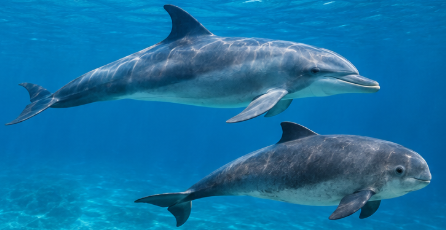
What Is a Dolphin?
A dolphin is a marine mammal belonging to the cetacean group. Dolphins are toothed whales, which means they have teeth rather than baleen plates.
Dolphins are known for their streamlined bodies, elongated beaks, curved dorsal fins, and highly social behavior. Many species live in groups called pods and communicate using a variety of sounds.
Dolphins can be found in oceans around the world, from warm tropical waters to colder regions.
One interesting fact is that orcas are actually members of the dolphin family. Although they are commonly called killer whales, orcas are the largest members of the Delphinidae family.
What Is a Porpoise?
A porpoise is also a marine mammal and belongs to the cetacean group. Porpoises are part of the family Phocoenidae.
Compared with dolphins, porpoises generally have shorter, stockier bodies and shorter faces. Their dorsal fins are typically triangular, and their teeth are flattened or spade-shaped.
Porpoises are generally more difficult to spot than dolphins because they tend to be less social and may avoid boats.
There are six recognized species of porpoises, including the harbor porpoise and the critically endangered vaquita.
1. Body Shape
One of the easiest ways to compare a porpoise vs dolphin is by looking at the body.
Dolphins generally have long, lean, streamlined bodies that are built for efficient swimming. Their shape helps them move quickly through the water.
Porpoises tend to have shorter and stockier bodies. They can appear more compact than dolphins when seen from the side.
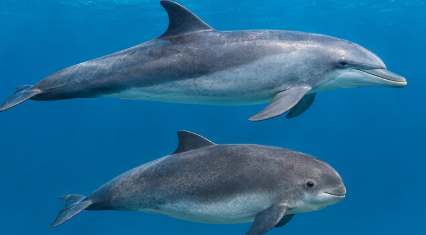
These differences are not always obvious when an animal is swimming far away, but they become much easier to notice when you can see the animal clearly.
2. Face and Beak
The shape of the face is another major difference.
Dolphins usually have a noticeable elongated beak, sometimes called a rostrum. This gives many dolphins the familiar long-nosed appearance people associate with these animals.
Porpoises generally have much shorter faces and do not have the prominent beak seen in many dolphins.
This means that if you see a marine mammal with a long, obvious beak, it is more likely to be a dolphin.
3. Teeth Are Different
Their teeth provide another useful clue.
Dolphins generally have pointed, cone-shaped teeth. These teeth help them grip fish, squid, and other prey.
Porpoises have flatter, spade-shaped teeth. Their teeth are adapted for gripping prey rather than chewing it.
So, if you could safely observe the teeth of a dolphin and a porpoise side by side, the difference would be quite noticeable.
4. Dorsal Fin Shape
The dorsal fin is the fin located on the animal’s back.
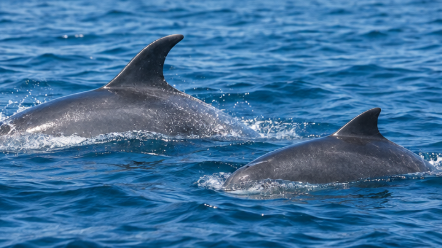
Dolphins commonly have a curved or sickle-shaped dorsal fin. This is one of the most recognizable features of many dolphin species.
Porpoises generally have a smaller, triangular dorsal fin.
When an animal briefly surfaces and only its back and fin are visible, the dorsal fin can therefore provide a useful clue about whether you are looking at a dolphin or a porpoise.
5. Dolphins Are Generally More Social
Dolphins are famous for their social behavior.
Many dolphin species live in groups called pods. They may cooperate while feeding, communicate with one another, and display complex social behaviors.
Porpoises can also live in groups, but they are generally less social than dolphins and are often more shy around boats and humans.
This does not mean every dolphin is friendly or every porpoise is solitary. Behavior varies between species and populations.
6. How Do Dolphins and Porpoises Communicate?
Dolphins and porpoises both use sound to navigate and find prey.
This ability is known as echolocation. They produce sounds and use returning echoes to gather information about objects and animals around them.
Dolphins are well known for producing clicks, whistles, squeaks, and other sounds. Their vocal communication can be quite complex.
Porpoises also use high-frequency clicks, but they generally do not communicate with the same types of whistles associated with dolphins.
Scientists believe differences in their anatomy may help explain why the two groups produce and use sounds differently.
7. Where Do Dolphins Live?
Dolphins have a broad geographic range.
Different dolphin species live in tropical, temperate, and other ocean environments. Some species live close to coastlines, while others spend much of their time farther offshore.
For example, bottlenose dolphins can be found in both coastal and offshore environments.
Because there are many different dolphin species, their preferred habitats can vary considerably.
8. Where Do Porpoises Live?
Porpoises are often associated with coastal waters, particularly in cooler regions.
The harbor porpoise, for example, can live in coastal waters and shallow areas such as bays and harbors.
Porpoises generally have a narrower geographic range than dolphins, although their exact habitat depends on the species.
The vaquita is an especially notable example. It has an extremely limited range in the northern Gulf of California.
9. What Do Dolphins and Porpoises Eat?
Both dolphins and porpoises are toothed marine mammals that eat animal prey.
Depending on the species, their diet can include fish, squid, and other marine animals.
Dolphins can use their teeth and beaks to capture prey, while porpoises use their shorter mouths and spade-shaped teeth to grip prey.
Most toothed whales swallow prey rather than chewing it in the way humans do.
If you want to learn more about animal diets, you can also read our guide on What Do Wild Animals Eat?.
10. Are Dolphins and Porpoises the Same Animal?
No. Dolphins and porpoises are not the same animals.
They are both marine mammals and both belong to the cetacean group, but they belong to different families.
Dolphins generally belong to the dolphin family Delphinidae, while porpoises belong to the family Phocoenidae.
Their physical characteristics and behaviors also help distinguish them from one another.
So, calling a porpoise a dolphin is not technically correct, even though the two can look similar at first glance.
11. Are Dolphins and Porpoises Whales?
Yes, in a scientific classification sense, dolphins and porpoises are part of the whale group known as cetaceans.
More specifically, dolphins and porpoises are toothed whales, or odontocetes.
The word “whale” is commonly associated with large animals such as blue whales and humpback whales, but the cetacean group also includes dolphins and porpoises.
This is why dolphins and porpoises are more closely connected to whales than many people realize.
12. Which Is Bigger
In general, dolphins tend to have longer and more streamlined bodies, while porpoises tend to be smaller and stockier.
However, size varies significantly among species.
Some dolphins can become quite large. Orcas, for example, are the largest members of the dolphin family.
Porpoises generally remain much smaller, with the vaquita being one of the smallest cetaceans.
Therefore, species should always be considered when making an exact size comparison.
13. Which Is More Intelligent?
Both dolphins and porpoises have large, complex brains and use echolocation.
Dolphins have been extensively studied for their social behavior, communication, problem-solving abilities, and learning.
Porpoises are also intelligent marine mammals, but they have generally received less scientific and behavioral attention than dolphins.
It would therefore be misleading to simply say that one group is “smart” and the other is not. Both have evolved sophisticated abilities that help them survive in their underwater environments.
14. Why Do People Confuse Dolphins and Porpoise
The main reason is their appearance.
Both animals have smooth bodies, flippers, dorsal fins, blowholes, and similar swimming styles. Both are also marine mammals that spend their lives in the water.
When one briefly surfaces in the distance, it may be difficult to identify it correctly.
Looking at the beak, teeth, body shape, and dorsal fin gives you some of the best clues.
More Weird Animal Facts You Should Know
If you want a simple way to remember the differences, think about these four features:
Dolphin:
- Longer beak
- Cone-shaped teeth
- Curved dorsal fin
- Generally more social
Porpoise:
- Shorter face
- Spade-shaped teeth
- Triangular dorsal fin
- Generally more shy
These characteristics are general guidelines, but they make identifying the two groups much easier.
Frequently Asked Questions
Are porpoises and dolphins the same?
No. Dolphins and porpoises are different marine mammals. They belong to different families and have differences in their teeth, faces, fins, body shapes, and behavior.
Can dolphins and porpoises live in the same ocean?
Yes. Their ranges can overlap in some areas, although individual species have different habitat preferences.
Do dolphins and porpoises both use echolocation?
Yes. Both groups use echolocation to help navigate, locate prey, and understand their underwater surroundings.
Do porpoises have beaks?
Porpoises generally do not have the long, prominent beaks commonly associated with dolphins. Their faces are shorter and more rounded.
Do porpoises whistle like dolphins?
Porpoises generally do not produce the same type of whistles commonly associated with dolphins. They rely heavily on high-frequency clicks for communication and echolocation.
Are porpoises endangered?
Some porpoise species face serious conservation threats. The vaquita, for example, is critically endangered and has an extremely restricted range.
What Is the Difference Between a Porpoise vs Dolphin?
The easiest differences to remember are their face, teeth, dorsal fin, and body shape. Dolphins generally have longer beaks, cone-shaped teeth, curved dorsal fins, and leaner bodies, while porpoises generally have shorter faces, spade-shaped teeth, triangular dorsal fins, and stockier bodies.
Final Thoughts
The porpoise vs dolphin comparison shows that these two marine mammals are similar in some important ways but are not the same animal.
Dolphins are generally more streamlined, have longer beaks, cone-shaped teeth, and curved dorsal fins. Porpoises tend to have shorter faces, stockier bodies, spade-shaped teeth, and triangular dorsal fins.
Both animals are fascinating members of the cetacean group and play important roles in marine ecosystems. Learning how to recognize their differences is a simple way to better understand the incredible diversity of ocean life.