
Birds of prey are some of the most impressive animals found in the natural world. With sharp talons, powerful beaks, excellent eyesight, and remarkable flying abilities, these birds have evolved to become highly skilled hunters. From a bald eagle soaring over a river to a peregrine falcon diving at incredible speed, birds of prey have fascinated people for centuries.
The term birds of prey generally refers to birds that hunt and feed on other animals. Many species are excellent predators, using their vision, speed, strength, and specialized body structures to locate and capture food. Eagles, hawks, falcons, owls, kites, and harriers are among the best-known examples.
Beyond their impressive hunting skills, birds of prey play an important role in healthy ecosystems. They help control populations of rodents, insects, fish, reptiles, and other animals. Their presence can also tell scientists a great deal about the condition of an environment.
In this guide, we will explore what birds of prey are, how they hunt, where they live, what they eat, and some of the most fascinating species found around the world.
What Are Birds of Prey?
Birds of prey are predatory birds that have evolved physical and behavioral adaptations for hunting and eating animals. They are sometimes called raptors, a word derived from the Latin term rapio, meaning “to seize” or “to take by force.”
Most birds of prey share several important characteristics. They usually have strong feet equipped with sharp talons, hooked beaks for tearing food, and excellent eyesight that helps them locate prey.
However, birds of prey are not all alike. Some, such as eagles and hawks, are active mainly during the day. Others, including many owls, are specially adapted to hunting at night.
Different species have also developed different hunting techniques. Some soar high above the ground before diving toward prey, while others wait quietly on a branch and launch a sudden attack.
Common Characteristics of Birds of Prey
Although birds of prey vary greatly in size, shape, and habitat, several features are commonly associated with these remarkable birds.
Sharp Talons
One of the most recognizable features of a raptor is its talons. These curved claws are designed to grab, hold, and sometimes kill prey.
Eagles and hawks often have particularly powerful feet because they may capture animals that are relatively large compared with their own body size.
Powerful Beaks
Birds of prey generally have hooked beaks. The sharp, curved shape allows them to tear meat into smaller pieces.
Unlike birds that mainly eat seeds or fruit, raptors do not need broad, flat bills for crushing plant material. Their beaks are specialized for a very different type of diet.
Excellent Eyesight
Vision is extremely important to hunting birds. Many raptors can spot potential prey from considerable distances.
Large eyes, specialized retinas, and other visual adaptations allow them to detect movement and judge distance while flying. This gives them a major advantage when searching for prey in open landscapes.
Strong Wings
Many birds of prey spend considerable amounts of time in the air. Eagles, vultures, and some hawks can use rising air currents to soar without constantly flapping their wings.
Falcons, on the other hand, are known for speed and controlled aerial movement.
Different Types of Birds of Prey
The world of birds of prey includes many different groups and species. Some are closely associated with forests, while others prefer mountains, wetlands, deserts, grasslands, or coastal environments.
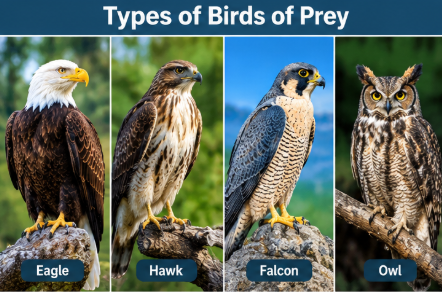
Eagles
Eagles are among the largest and most powerful birds of prey. They are known for their impressive wingspans, strong feet, and powerful hunting abilities.
Species such as the bald eagle and golden eagle have become especially well known.
Many eagles hunt fish, mammals, birds, and reptiles. Their large talons allow them to grasp prey firmly, while their broad wings help them soar over large territories.
Hawks
Hawks are found in many parts of the world and occupy a wide range of habitats. They are often medium-sized compared with large eagles.
Hawks generally have excellent vision and strong talons. Many species hunt small mammals such as mice and rabbits, while others feed on birds, reptiles, or insects.
Their hunting styles vary. Some patrol open areas from the air, while others sit quietly on elevated perches and wait for prey to appear.
Falcons
Falcons are famous for their speed and agility. They tend to have long, pointed wings and streamlined bodies that allow them to maneuver quickly through the air.
The peregrine falcon is particularly famous for its high-speed hunting dives. It can fold its wings and descend rapidly toward prey, making it one of nature’s most remarkable aerial predators.
Owls
Owls are also birds of prey, although their appearance and behavior are quite different from those of eagles and hawks.
Many owls are nocturnal, meaning they are most active at night. Their large eyes help them see in low-light conditions, while their highly developed hearing can help them detect prey.
Many owls also have specially adapted feathers that allow them to fly with surprisingly little noise. This can help them approach prey without being detected.
Kites
Kites are generally graceful fliers and are often seen soaring or gliding over open landscapes.
Many species feed on small animals, insects, fish, or carrion. Some kites are opportunistic feeders and may take advantage of whatever food is available in their environment.
Harriers
Harriers are often associated with grasslands, marshes, and other open habitats. They commonly fly low over vegetation while searching for prey.
Their distinctive hunting style involves using both sight and sound to locate animals hidden beneath grass or vegetation.
Vultures
Vultures are often included among birds of prey, although their feeding behavior is different from that of active hunters.
Many vultures primarily feed on carrion, meaning the bodies of animals that have already died. This makes them important members of ecosystems because they help remove dead animals from the environment.
How Do Birds of Prey Hunt?
The hunting technique used by a bird of prey depends on its species, habitat, body structure, and preferred food.
Some raptors hunt from the sky. They may soar over an area, identify prey below, and then dive toward it.
Others prefer a sit-and-wait strategy. A hawk might perch on a tree branch or pole and carefully watch the ground. When it spots a small mammal, it can quickly launch itself into the air.
Falcons often rely on speed and aerial maneuvering. Owls use darkness, hearing, and silent flight to approach prey.
This variety of hunting strategies is one reason birds of prey are so successful in different environments.
What Do Birds of Prey Eat?
The diet of birds of prey varies considerably between species.
Common food sources include:
- Small mammals
- Birds
- Fish
- Reptiles
- Amphibians
- Insects
- Carrion
- Occasionally other small animals
A golden eagle, for example, may hunt mammals and birds, while an osprey specializes heavily in catching fish. An owl may feed on mice, rats, small birds, and other small animals.
The availability of food also influences what a bird eats. A predator may change its diet depending on the season and the prey species available in its habitat.
Where Do Birds of Prey Live?
Birds of prey can be found on almost every continent and in an enormous variety of environments.
Some species live in forests, where trees provide nesting sites and hunting perches. Others prefer open grasslands where prey is easier to see from the air.
Mountains are home to several eagle and vulture species, while wetlands and rivers attract birds such as ospreys and certain types of hawks.
Owls can live in forests, deserts, grasslands, cities, and even agricultural landscapes.
This adaptability has allowed birds of prey to become important predators in many different ecosystems.
Birds of Prey and the Food Chain
Birds of prey occupy important positions in food webs. As predators, they help regulate populations of other animals.
For example, a hawk that regularly catches rodents can influence the number of mice and rats in an area. Owls can also play an important role in controlling populations of small mammals.
This natural form of population control can contribute to ecosystem balance.
Birds of prey are also part of complex food webs themselves. Young or injured raptors may become prey for other animals, while their eggs and nestlings can face threats from predators.
Why Are Birds of Prey Important?
The importance of birds of prey extends far beyond their ability to hunt.
Natural Population Control
Predatory birds help keep populations of prey species within the limits of their environment. This can prevent certain species from becoming excessively abundant.
Removing Carrion
Scavenging birds such as vultures help remove dead animals. This contributes to nutrient cycling and can reduce the amount of decaying material left in the environment.
Indicators of Environmental Health
Because many raptors depend on healthy habitats and reliable food supplies, changes in their populations can provide useful information about environmental conditions.
Scientists often monitor birds of prey to understand changes in ecosystems, pollution levels, habitat quality, and food availability.
Birds of Prey Around the World
Different regions have their own remarkable raptor species.
North America is home to bald eagles, golden eagles, red-tailed hawks, peregrine falcons, and numerous owl species.
Europe has species such as the Eurasian eagle-owl, common buzzard, golden eagle, and peregrine falcon.
Africa supports an extraordinary diversity of raptors, including martial eagles, bateleurs, secretarybirds, and several vulture species.
Asia is home to many eagles, hawks, falcons, and owls, while Australia has distinctive species such as the wedge-tailed eagle.
South America also supports an impressive variety of predatory birds, including the powerful harpy eagle.
The Harpy Eagle
The harpy eagle is one of the most striking birds of prey in the world. It lives primarily in tropical forests of Central and South America.
It has extremely powerful legs and large talons that allow it to capture substantial prey. Its appearance is distinctive, with a prominent crest and broad wings.
The species is closely associated with mature forests, making habitat conservation especially important for its survival.
The Bald Eagle
The bald eagle is one of the best-known birds of prey in North America. Adults have a distinctive white head and tail contrasting with a darker body.
Bald eagles are strongly associated with waterways because fish form an important part of their diet.
They may build very large nests in tall trees or other suitable locations. Their recovery in areas where populations were once severely reduced is an important example of successful wildlife conservation.
The Peregrine Falcon
The peregrine falcon is renowned for its speed, agility, and ability to hunt other birds in flight.
Its streamlined body and pointed wings are perfectly suited to aerial hunting. Peregrine falcons can live in a variety of habitats and have also adapted to some urban environments.
Tall buildings can provide nesting locations that resemble the cliffs these birds naturally use.
The Golden Eagle
The golden eagle is a powerful raptor found across parts of the Northern Hemisphere.
It prefers open landscapes, mountains, and rugged terrain where it can use its excellent eyesight to locate prey.
Golden eagles are capable hunters and may take mammals, birds, and reptiles. Their ability to soar over large areas allows them to search efficiently for food.
Birds of Prey in Urban Areas
It may seem surprising, but some birds of prey have adapted remarkably well to cities and towns.
Peregrine falcons, for example, have established populations in some urban areas. Tall buildings can resemble natural cliffs, while city environments may support abundant prey such as pigeons.
Other raptors can use parks, green spaces, roadside trees, and even artificial structures as hunting or nesting areas.
Seeing a hawk or falcon in an urban environment is therefore not necessarily unusual. In some places, cities have become an important part of the habitat used by these adaptable birds.
Threats Facing Birds of Prey
Despite their strength and impressive hunting abilities, birds of prey can be vulnerable to environmental changes.
Some major threats include:
- Habitat loss
- Pollution
- Reduced food availability
- Illegal persecution
- Collisions with vehicles and structures
- Disturbance around nesting sites
- Climate and environmental changes
Because many raptors occupy large territories and reproduce relatively slowly, population declines can sometimes take considerable time to reverse.
How Can We Help Birds of Prey?
Protecting birds of prey begins with protecting the ecosystems they depend on.
Preserving forests, wetlands, grasslands, rivers, and other natural habitats provides raptors with places to hunt, rest, and reproduce.
People can also help by avoiding unnecessary disturbance near active nests and by supporting responsible wildlife conservation programs.
If you find an injured bird of prey, it is generally best not to handle it unnecessarily. Contacting a qualified wildlife rehabilitator or appropriate local wildlife authority is safer for both the bird and the person attempting to help.
Fascinating Facts About Birds of Prey
Here are some interesting facts about these remarkable animals:
- Many birds of prey have extremely sharp vision that helps them locate prey from a distance.
- Falcons are specialized for fast and agile flight.
- Many owls can fly very quietly because of special feather adaptations.
- Vultures play an important role as scavengers.
- Some raptors have adapted successfully to urban environments.
- Eagles can have exceptionally large wingspans.
- Different species use very different hunting strategies.
- Birds of prey can be found in deserts, forests, mountains, wetlands, grasslands, and cities.
- Raptors help regulate populations of many prey animals.
- Some birds of prey can live for many years when they have suitable habitat and sufficient food.
Why Birds of Prey Deserve Our Attention
Birds of prey are more than impressive hunters. They are important components of natural ecosystems and have evolved an extraordinary combination of strength, intelligence, vision, speed, and adaptability.
Watching an eagle circle above a mountain, hearing an owl call after sunset, or seeing a falcon move rapidly through the sky offers a reminder of how diverse wildlife can be.
Learning about these birds also helps us understand the connections between predators, prey, habitats, and environmental health. Protecting raptors means protecting the landscapes and food webs that support them.
Final Thoughts
Birds of prey represent some of nature’s most remarkable examples of adaptation. Their powerful talons, hooked beaks, exceptional eyesight, specialized wings, and unique hunting techniques have allowed them to thrive in environments across the globe.
From massive eagles and graceful hawks to fast-moving falcons and mysterious owls, every species has its own role in the natural world.
Whether they are actively hunting, soaring above a landscape, caring for young in a nest, or silently moving through the night, birds of prey continue to capture our attention. Understanding these fascinating birds is an important step toward appreciating and protecting the ecosystems they call home.
For anyone interested in wildlife, birds of prey offer an incredible subject to explore. Their lives reveal just how complex, competitive, and beautiful the natural world can be.