
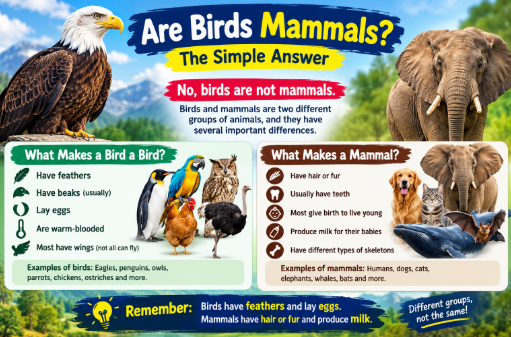
No, birds are not mammals. Birds and mammals belong to two different groups of animals, and they have several important differences.
Birds have feathers, beaks, wings, and lay eggs. Mammals, on the other hand, have hair or fur and feed their babies with milk.
But there is more to the answer than that. Let’s look at what makes birds different from mammals and what characteristics define each group.
Are Birds Mammals?
Birds are not mammals. They belong to a separate animal group called Aves.
All birds share some important characteristics. They have feathers, lay eggs, have beaks, and are warm-blooded animals. Most species also have wings, although not every bird can fly.
Mammals belong to a different group called Mammalia. Humans, dogs, cats, elephants, whales, and bats are all examples of this animal group.
What Makes a Bird a Bird?
One of the easiest ways to recognize a bird is by its feathers.
Feathers are unique to birds and help them stay warm, protect their bodies, attract mates, and, in many species, support flight.
Birds also have beaks instead of teeth in most cases. They reproduce by laying eggs, and their young usually hatch from those eggs.
Examples of birds include:
- Eagles
- Penguins
- Owls
- Parrots
- Chickens
- Ostriches
Even species that cannot fly, such as penguins and ostriches, are still birds because they have the basic characteristics of the Aves group.
What Makes Birds Different?
Birds and mammals are both warm-blooded animals, but they have several major differences.
| Birds | Mammals |
|---|---|
| Have feathers | Have hair or fur |
| Usually have beaks | Usually have teeth |
| Lay eggs | Most give birth to live young |
| Do not produce milk for their babies | Produce milk for their babies |
| Many have lightweight skeletons adapted for flight | Have different types of skeletons |
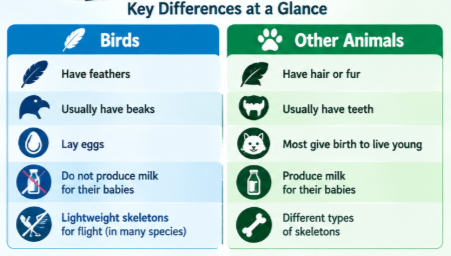
The biggest difference is that mammals produce milk to feed their young, while birds do not.
However, there are exceptions to some common rules. For example, not every bird can fly, and a small number of mammals lay eggs. This is why scientists use a combination of characteristics to classify animals.
Do Birds Give Birth to Babies?
Birds do not give birth to live babies like most mammals do.
Instead, female birds lay eggs. The baby develops inside the egg and eventually hatches.
After hatching, many young birds depend on their parents for food, warmth, and protection until they are old enough to survive on their own.
There are a few mammals that lay eggs, such as the platypus and echidnas, so laying eggs alone does not make an animal a bird.
Platypuses and echidnas are unusual because they are mammals that reproduce by laying eggs. They are part of a special group known as monotremes.
Do Birds Have Hair Like Mammals?
No. Birds do not have hair or fur like mammals.
Instead, they have feathers. Feathers help keep the body warm, protect the skin, assist with flight in many species, and can also play an important role in communication and attracting mates.
Mammals have hair at some point during their lives, although the amount and appearance can vary greatly between species.
This difference in body covering is one of the easiest ways to distinguish the two animal groups.
Are Birds Related to Dinosaurs?
Yes. Birds are actually the living descendants of a group of dinosaurs.
Scientists have found many similarities between modern birds and certain theropod dinosaurs. Fossil evidence also shows that several bird-like characteristics developed among dinosaur groups over millions of years.
This is why modern birds are often described as the only dinosaurs still living today.
So while birds are not mammals, they are closely connected to the dinosaur family tree.
Why Are Birds and Mammals Both Warm-Blooded?
One interesting similarity between the two groups is that both are warm-blooded, meaning they can maintain a relatively stable internal body temperature.
This ability allows them to remain active across a range of environmental conditions.
Despite this similarity, their bodies have evolved in different ways. Birds have feathers, beaks, and a reproductive system based on eggs, while mammals are characterized by features such as hair and milk production.
Do All Birds Fly?
No. Flying is not a requirement for an animal to be classified as a bird.
Penguins, ostriches, emus, kiwis, and cassowaries are examples of birds that cannot fly. Their bodies have evolved for other ways of moving and surviving.
Penguins, for example, use their wings as flippers for swimming, while ostriches have powerful legs that allow them to run at high speeds.
This shows that having feathers and other bird characteristics is more important for classification than the ability to fly.
Final Answer: Do Birds Belong to the Mammal Group?
No, birds are not mammals.
Birds belong to the group Aves, while mammals belong to Mammalia. Birds have feathers and lay eggs, while mammals have hair or fur and produce milk to feed their young.
Although the two groups share some features, such as being warm-blooded, they are separate groups of animals with different evolutionary histories and physical characteristics.
The next time you see an eagle, penguin, chicken, or tiny sparrow, you can be sure of one thing: it is a bird, not a mammal.
Frequently Asked Questions
Are Birds and Mammals?
No, birds are not mammals. Birds have feathers and lay eggs, while mammals have hair or fur and produce milk for their young.
What Type of Animal Is a Bird?
Birds belong to the animal group called Aves. They are warm-blooded vertebrates with feathers, beaks, and other characteristics that distinguish them from other animal groups.
Do Birds Give Birth Like Mammals?
No. Birds lay eggs, and their babies develop inside the eggs before hatching.
What Is the Main Difference Between Birds and Mammals?
The main difference is that mammals produce milk to feed their young and have hair at some point in their lives, while birds have feathers and reproduce by laying eggs.
Are Any Mammals Able to Lay Eggs?
Yes. Platypuses and echidnas are mammals that lay eggs. They belong to a small group of mammals called monotremes.
Are Birds Related to Dinosaurs?
Yes. Modern birds evolved from theropod dinosaurs and are considered the living descendants of this dinosaur lineage.