
The deep ocean is one of the least explored environments on Earth, and deep sea fish are among its most fascinating inhabitants. Far below the surface, sunlight disappears, temperatures are low, food can be scarce, and water pressure becomes enormous. Yet many fish have evolved remarkable ways to survive in these conditions.
Some deep-sea species produce their own light, while others have enormous mouths, sensitive eyes, unusual body shapes, or extremely dark skin. Species such as anglerfish, viperfish, gulper eels, lanternfish, tripod fish, and abyssal grenadiers show just how different life can become in the deep ocean.
But what exactly makes a fish a deep sea fish, and how do these animals survive where ordinary surface-dwelling fish would struggle?
What Are Deep Sea Fish?
Deep sea fish are fish that live in the deeper parts of the ocean, particularly in environments where sunlight is greatly reduced or absent. The term does not describe one particular family or group of fish. Instead, it refers broadly to fish adapted to life in deep-ocean habitats.
The deep ocean is not a single uniform environment. Conditions change with depth, and different fish occupy different zones. Many species live in the open water column, while others spend much of their lives near the seafloor.
The deeper these fish live, the more important specialized adaptations become. Darkness, pressure, low temperatures, and limited food all influence their body structure and behavior.
Where Do Deep Sea Fish Live?
Deep sea fish can be found hundreds or thousands of meters below the ocean surface. One important boundary is around 200 meters, where sunlight becomes increasingly limited. At greater depths, the environment becomes progressively darker.
The bathypelagic, or “midnight,” zone extends roughly from 1,000 to 4,000 meters below the surface. There is essentially no sunlight available for photosynthesis in this region, creating a very different ecosystem from the sunlit surface ocean.
Even deeper regions include the abyssal zone. Smithsonian Ocean notes that the abyssopelagic environment extends from about 4,000 to 6,000 meters, where animals must tolerate extremely high pressure.
How Do deep-sea species Survive?
Deep sea fish have evolved a variety of adaptations that help them cope with their unusual environment.
1. Bioluminescence
One of the most famous adaptations is bioluminescence—the ability of a living organism to produce light through a chemical reaction.
In the dark ocean, this light can have several functions. Depending on the species, it may help attract prey, communicate, locate potential mates, or confuse or deter predators.
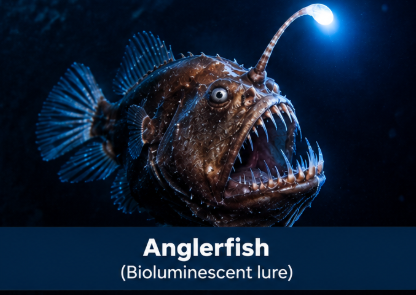
Anglerfish are a classic example. Many deep-sea anglerfish use a glowing structure called an esca at the end of a modified fin ray. The light can act as a lure for prey. In many species, the light is produced through a relationship with bioluminescent bacteria.
2. Sensitive or Specialized Eyes
Although sunlight is absent at great depths, some deep sea fish still have highly specialized eyes.
Bioluminescent organisms provide small amounts of light in the darkness, so the ability to detect faint flashes can be useful. Some deep-sea animals have large eyes or visual systems adapted to the limited wavelengths of light available in their environment.
Not every deep sea fish depends heavily on vision, however. Other senses can be important for detecting movement, vibrations, chemicals, and nearby prey.
3. Large Mouths and Expandable Stomachs
Food can be unpredictable in the deep ocean. When an opportunity to eat appears, a fish may need to consume as much as possible.
Some deep sea fish have unusually large mouths and expandable stomachs that allow them to swallow surprisingly large prey relative to their body size. The gulper eel is a well-known example, with a very large expandable mouth and throat.
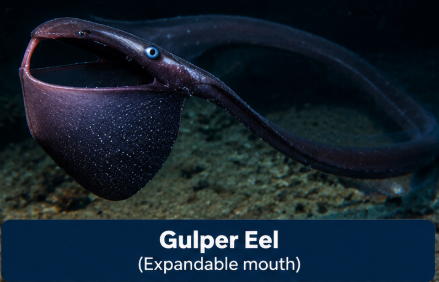
This adaptation is particularly useful in an environment where meals may be separated by long periods of scarcity.
4. Energy-Saving Bodies
Because food is often limited, many deep-ocean fish have lifestyles that help conserve energy.
Some move slowly rather than constantly swimming. The abyssal grenadier, for example, is adapted to cold, dark, high-pressure environments and is described by Smithsonian Ocean as moving slowly while searching for scarce food.
This is an important principle of deep-sea survival: when energy is difficult to obtain, wasting it can be dangerous.
5. Dark or Ultra-Black Skin
Dark coloration can also provide camouflage in the deep ocean. Some fish living in the deep ocean have extremely dark skin that absorbs much of the available light.
Research documented by NOAA found evidence of ultra-black skin in multiple deep-sea fish species. Such pigmentation can reduce the amount of light reflected from the body, potentially making the fish harder for predators or prey to detect when illuminated by bioluminescence.
Examples of Deep Sea Fish
The deep ocean contains many unusual fish species and groups.
| Deep sea fish | Notable adaptation |
|---|---|
| Anglerfish | Bioluminescent lure for attracting prey |
| Viperfish | Large teeth and specialized predatory features |
| Gulper eel | Huge expandable mouth |
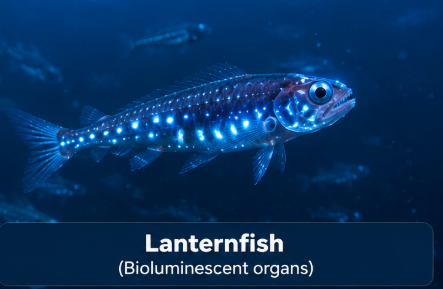
| Lanternfish | Bioluminescent organs |
| Tripod fish | Long fin structures used while resting on the seafloor |
| Abyssal grenadier | Adapted to extreme depth, cold, and scarce food |
Tripod fish are particularly unusual. They can use elongated fins as rigid supports, allowing them to position themselves above the seafloor while waiting for food.
Why Is the Deep Ocean So Difficult for Fish?
The deep ocean presents several major challenges.
First, pressure increases as depth increases. NOAA explains that water pressure rises by about one atmosphere for every 10 meters of depth. At 1,000 meters, the pressure is therefore dramatically greater than at the surface.
Second, there is almost no sunlight in the deepest regions. Without sunlight, photosynthesis cannot occur, which contributes to the limited availability of food in many deep-ocean habitats.
Third, temperatures are generally cold. NOAA notes that below roughly 200 meters, ocean water has an average temperature of around 4°C, although actual temperatures vary by location and conditions.
Together, these conditions make deep-ocean ecosystems very different from shallow coastal environments.
What Do Deep Sea Fish Eat?
The diet of deep-sea animals varies considerably by species and habitat.
Some are predators that hunt fish, squid, crustaceans, or other animals. Others feed near the seafloor, where organic material sinks from upper waters. This falling material is often called “marine snow.”
In the deep ocean, food is generally much less abundant than in sunlit surface waters. As a result, many species have evolved behaviors and body structures that help them locate food efficiently and make the most of rare feeding opportunities.
Are Deep Sea Fish Dangerous?
Most deep sea fish are not a danger to humans because people rarely encounter them in their natural environment.
Some species look frightening because of their oversized teeth, enormous mouths, or unusual bodies. These features are generally adaptations for surviving in a difficult environment rather than signs that the fish is aggressive toward humans.
In fact, many ocean fish are small, delicate, slow-moving, or highly specialized.
Why Are Deep Sea Fish Important?
deep-water species are important parts of ocean food webs. They help transfer energy through deep-water ecosystems and interact with numerous other marine organisms.
Studying them also gives scientists insight into how life adapts to extreme environments. Their unusual eyes, pigmentation, feeding strategies, sensory systems, and bioluminescence demonstrate how evolution can produce very different solutions to environmental challenges.
Scientists are still learning about many deep-ocean species. Because these animals live in difficult-to-reach habitats, observing their behavior in their natural environment can be challenging.
Frequently Asked Questions
What is a deep sea fish?
A these fish is a fish adapted to living in deeper ocean environments, particularly where sunlight is weak or absent. Different species occupy different depths and habitats.
Do deep sea fish have eyes?
Many deep sea fish have eyes, and some have highly sensitive vision adapted to very low levels of light. Others rely more heavily on non-visual senses.
Why do deep sea fish glow?
Some deep sea fish produce light through bioluminescence. Depending on the species, the light can help attract prey, communicate, find mates, or deter predators.
What is the most famous deep sea fish?
The anglerfish is one of the most recognizable deep sea fish because many species have a distinctive glowing lure used to attract prey.
What do deep sea fish eat?
Their diets vary. Depending on the species, they may eat smaller fish, squid, crustaceans, other animals, or organic material that sinks from upper parts of the ocean.
How deep can fish live?
Some fish have been recorded at several thousand meters below the ocean surface. For example, Smithsonian Ocean lists the abyssal grenadier at depths of about 5,180 meters.
Final Thoughts
Deep sea fish show how remarkably adaptable life can be. In an environment defined by darkness, cold, enormous pressure, and limited food, these animals have evolved specialized ways to find prey, conserve energy, communicate, avoid predators, and reproduce.
From the glowing lure of an anglerfish to the unusual fins of a tripod fish and the extreme pigmentation of ultra-black species, deep sea fish are far more diverse than their strange appearances might suggest. The deeper scientists explore the ocean, the more evidence they find that the deep sea contains ecosystems with adaptations that are still being discovered and understood.